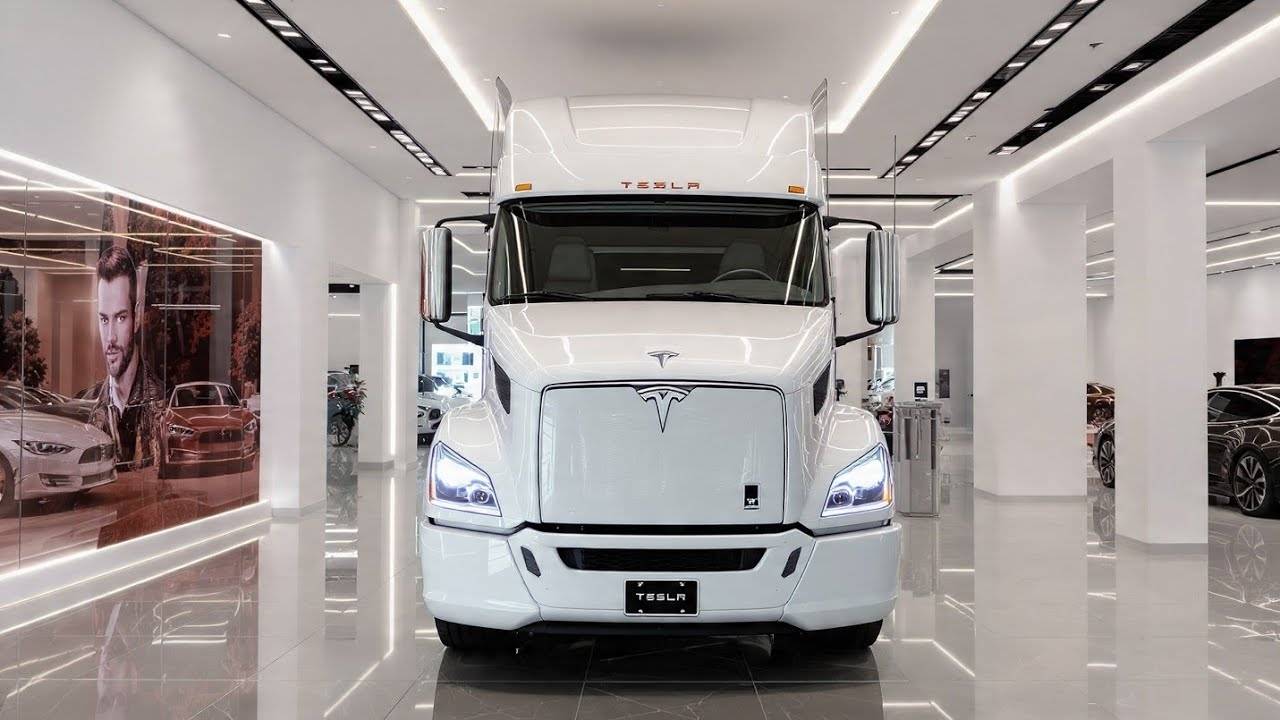
The Tesla Semi represents one of the most ambitious attempts to bring battery electric technology into heavy duty trucking. Unlike electric passenger cars, a Class 8 tractor has to move enormous weights over long distances while operating for many hours at a time.

That makes the Tesla Semi a very different engineering challenge.
Tesla has positioned the Semi around long range capability, rapid charging, aerodynamic efficiency and lower operating costs. The 500 mile range figure has become one of the vehicle’s most discussed specifications, although real world range depends on payload, weather, terrain, speed and other operating conditions.

The 2026 Tesla Semi is therefore less about simply replacing a diesel engine with batteries and more about rethinking how long haul trucking could operate.
A Completely Different Truck
Traditional heavy duty trucks have been built around diesel engines for decades.

The diesel engine drives a transmission and mechanical drivetrain, while fuel tanks provide energy for long distance travel.
The Semi takes a different approach.

Electric motors provide propulsion, while a large battery pack stores energy.
This eliminates many traditional engine components and allows Tesla to control torque electronically.
For commercial fleets, the potential benefits extend beyond acceleration.
Lower energy and maintenance costs could become more important over millions of miles.
Futuristic Exterior Design
The Tesla Semi immediately stands apart from conventional Class 8 tractors.
Its aerodynamic shape is much smoother than the boxy profile commonly associated with American semis.
The sloped front helps reduce aerodynamic drag.
Smooth body surfaces guide airflow around the cab.
The windshield provides a large forward view.
The overall design looks more like a futuristic transportation machine than a traditional diesel tractor.
That aerodynamic focus is essential because reducing drag can have a major effect on energy consumption at highway speeds.
Aerodynamics Matter More Than Ever
For an electric truck, aerodynamic efficiency is critical.
At highway speeds, aerodynamic drag becomes one of the largest forces resisting forward motion.
Every improvement can reduce energy consumption.
The Semi’s streamlined cab helps minimize air resistance.
Wheel and underbody design also contribute to efficiency.
When the truck is pulling a large trailer, aerodynamic performance becomes even more important because the combined vehicle creates substantial drag.
The 500 Mile Question
The 500 mile range claim is one of the most important aspects of the Tesla Semi story.
Tesla has promoted a 500 mile version for long distance transportation.
However, range should never be interpreted as a guaranteed distance under every condition.
A heavily loaded tractor traveling at highway speed in cold weather can consume significantly more energy than a lightly loaded vehicle traveling at moderate speed.
Terrain also matters.
Long climbs can require substantial energy, while regenerative braking can recover some energy during descents.
For fleet operators, route specific energy planning is therefore essential.
Electric Power
Electric motors provide one major advantage over diesel engines.
Torque is available almost immediately.
The Semi can therefore accelerate smoothly without the gear changes associated with a conventional heavy truck.
Multiple electric motors can provide strong traction.
Electronic torque control can also manage power delivery more precisely.
This can make the driving experience remarkably smooth for such a large vehicle.
Heavy Hauling Performance
The Semi is designed for serious commercial transportation.
Its powertrain must handle the combined mass of tractor, trailer and cargo.
Electric motors are particularly well suited to this task because they produce strong low speed torque.
That can be useful when starting from a standstill with a heavy trailer.
The vehicle’s performance also benefits from regenerative braking, which can recover energy during deceleration.
Regenerative Braking
Regenerative braking is one of the major advantages of electric heavy vehicles.
When the driver slows down, the electric motors can operate as generators.
Instead of converting all the vehicle’s kinetic energy into heat through friction brakes, some energy can be returned to the battery.
This is particularly useful on routes involving frequent stops or long downhill sections.
Regeneration can also reduce wear on conventional brake components.
Battery Technology
The battery pack is the heart of the Semi.
A long range heavy truck requires an enormous amount of stored energy.
The battery must provide high power while remaining safe and reliable under demanding operating conditions.
Thermal management is therefore extremely important.
The system must control battery temperature during charging and heavy acceleration.
Battery durability will also be critical because commercial trucks can accumulate enormous mileage over their operating lives.
Charging Infrastructure
Charging is perhaps the biggest difference between an electric semi and a diesel truck.
A diesel tractor can be refueled relatively quickly at an established truck stop.
An electric truck requires sufficiently powerful charging infrastructure.
Tesla has developed high power charging technology specifically for the Semi.
The exact charging time depends on the charger, battery state, temperature and other conditions.
For fleet operators, charging infrastructure must be integrated into route planning and depot operations.
Megawatt Charging Potential
Long haul electric trucking requires much faster charging than passenger cars.
High power charging can replenish substantial energy in a relatively short period.
The objective is not necessarily to eliminate every charging stop.
Instead, charging can be coordinated with legally required driver rest periods and scheduled breaks.
If a fleet can charge while drivers are already stopped, the impact on productivity can be reduced.
This approach could become increasingly important as electric heavy trucks become more common.
Interior Design
The Semi’s cabin is dramatically different from traditional trucks.
The driver sits centrally in the cab rather than following the conventional left side driving position used in many American trucks.
This can improve visibility around the vehicle.
Large displays provide information about speed, energy use and vehicle status.
The minimalist dashboard gives the interior a distinctly Tesla character.
For professional drivers spending many hours behind the wheel, seat comfort and storage remain important considerations.
Driver Visibility
The central seating position can provide an unusual perspective.
The driver has improved visibility toward both sides of the truck.
Large windows and camera systems can further assist with awareness.
Blind spots remain a reality because of the size of the tractor and trailer.
Advanced cameras and sensors can help reduce the difficulty of maneuvering.
For docking and tight urban deliveries, visibility technology can be particularly valuable.
Interior Comfort
Long haul drivers need more than a powerful drivetrain.
They spend significant periods inside the vehicle.
A comfortable seat, climate control and practical storage are essential.
The Semi’s cabin is designed around modern controls and a simplified interface.
Depending on configuration, fleet operators may also integrate additional communication and logistics technology.
The final comfort package will depend on the production and fleet specification.
Software Driven Trucking
Software is another major part of the Tesla Semi concept.
Electric propulsion can be closely integrated with digital control systems.
Energy consumption can be monitored continuously.
Route planning can consider charging requirements.
Vehicle diagnostics can be performed electronically.
Over the long term, software updates could potentially improve vehicle functions without changing physical components.
For fleet operators, digital monitoring can help identify inefficient driving patterns and maintenance needs.
Safety Technology
Heavy trucks have large blind spots and require substantial stopping distances.
Advanced safety systems can therefore provide significant benefits.
Potential technologies include collision warning, automatic emergency braking, lane departure assistance and blind spot monitoring.
Cameras and sensors can provide additional information around the tractor.
The exact equipment depends on the production specification and regulatory requirements.
No driver assistance system removes the need for professional training and attentive driving.
Operating Cost Potential
This is arguably the biggest reason companies are interested in electric trucks.
Electric drivetrains contain fewer moving mechanical components than conventional diesel powertrains.
There is no traditional diesel engine oil system.
Regenerative braking can reduce friction brake wear.
Electric energy can also cost less than diesel on some routes, particularly when fleets can charge at favorable commercial electricity rates.
However, electricity prices, charging infrastructure, battery depreciation and maintenance all need to be considered.
Battery Weight
The biggest disadvantage of a large electric truck is battery mass.
A battery capable of storing enough energy for long distance heavy hauling is extremely large.
That weight can affect payload capacity.
For trucking companies, every kilogram matters because the vehicle earns money by moving cargo.
The economics of battery weight therefore remain an important engineering consideration.
Battery technology improvements could gradually reduce this disadvantage.
Range Under Real Conditions
The 500 mile figure should be treated as a target or rated capability rather than a universal real world promise.
Several factors can reduce range.
Cold weather can affect battery efficiency.
High winds increase aerodynamic resistance.
Heavy cargo increases energy consumption.
High speeds consume more energy.
Mountain routes require more power.
Tire condition and pressure also matter.
Fleet operators will therefore need to plan routes using realistic energy estimates rather than relying on a single headline number.
Price Truth
There is no simple universal retail price for a 2026 Tesla Semi.
Tesla’s commercial vehicle pricing, fleet agreements, incentives and regional arrangements can differ from normal passenger vehicle pricing.
The total cost of ownership is also more important for a fleet than the initial purchase price.
A diesel truck may have a lower or more familiar upfront cost, while an electric truck could potentially offset some of that difference through lower energy and maintenance expenses.
Any exact 2026 Semi price circulating online should therefore be verified against Tesla’s current commercial offering and the relevant market.
Tesla Semi Versus Diesel Trucks
The competition is not simply about horsepower.
Diesel trucks currently benefit from an enormous refueling network and decades of established fleet infrastructure.
Electric trucks offer potentially lower operating costs, smoother driving and reduced local emissions.
Diesel remains advantageous for routes where charging infrastructure is unavailable or where long range refueling speed is critical.
Electric trucks become more attractive when routes are predictable and charging can be installed at depots.
The best choice depends heavily on fleet operations.
Long Haul Potential
The Semi’s long range configuration is aimed at making electric transportation viable beyond short regional routes.
A 500 mile capability could cover substantial portions of daily freight operations.
Charging could be scheduled around driver rest periods.
Fleet managers could also design routes around charging infrastructure.
As charging networks expand, the practical operating area of electric semis could increase.
Environmental Impact
Electric trucks produce no tailpipe emissions while driving.
That can be particularly valuable in urban areas where heavy trucks contribute to local air pollution.
The overall environmental impact depends on how electricity is generated and how the battery is produced.
Nevertheless, replacing diesel combustion with electric propulsion can significantly reduce direct vehicle emissions.
For companies pursuing emissions reduction targets, this can be an important factor.
Industry Revolution
The Tesla Semi could have a larger impact than its sales volume alone suggests.
If electric heavy trucks demonstrate reliable performance and favorable operating economics, other manufacturers will have greater incentive to accelerate their own programs.
This could push improvements in charging infrastructure, battery technology and fleet management systems.
The transition will not happen overnight.
Heavy trucking has demanding requirements.
But the Semi demonstrates that battery electric technology can be considered for applications once viewed as too difficult to electrify.
Final Verdict
The 2026 Tesla Semi represents a major experiment in the future of heavy transportation.
Its aerodynamic design, electric motors, regenerative braking, advanced software and potential 500 mile range give it a completely different character from traditional diesel semis.
The biggest advantages are smooth electric performance, potentially lower maintenance requirements and the possibility of lower energy costs.
The biggest challenges remain battery weight, charging infrastructure, route planning and the real world impact of payload, weather and terrain on range.
The “price truth” is equally important. There is no single universally confirmed 2026 Tesla Semi retail price that applies to every fleet or market, so unofficial figures should be treated cautiously.
The Tesla Semi does not simply ask whether a truck can run on electricity. It asks whether an entire freight operation can be redesigned around electric power.
If charging infrastructure continues to expand and battery technology keeps improving, the Semi could become an important part of the industry’s transition away from diesel. For now, its greatest significance may be that it has made the idea of a long distance electric Class 8 truck feel far less futuristic than it once did.